On October 28, the 2023 Annual Conference of the Committee of College Foreign Language Journals, China Association for Comparative Studies of English and Chinese, was successfully held at Central South University (CSU). Hosted by the Committee and organized by the Editorial Office of Foreign Languages and Translation, School of Foreign Languages, the conference brought together Tan Xiaoping, Deputy Director of the Publishing House of CSU, Zhuang Zhixiang, President of the Committee, and nearly 60 journal editors and reviewers from member institutions. Professor Yang Wendi, Dean of the School of Foreign Languages, presided over the opening ceremony.
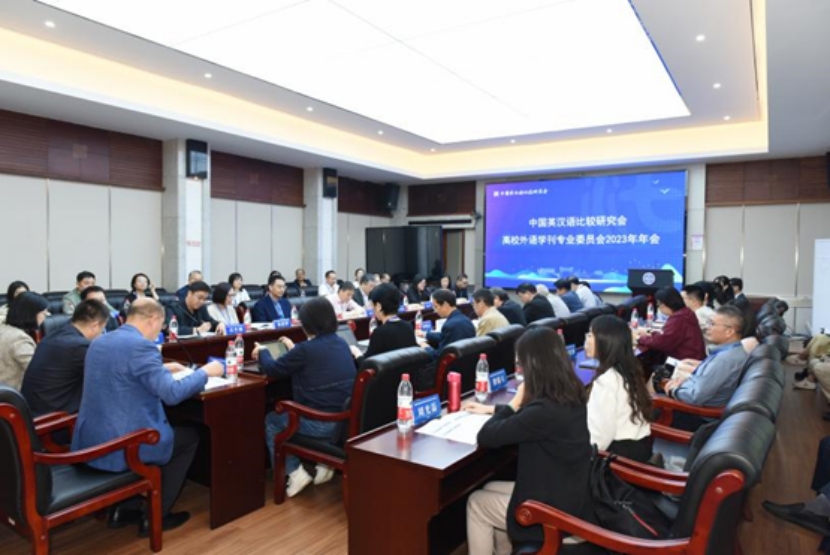
At the opening ceremony, Deputy Director Tan Xiaoping, representing the Publishing House of CSU, congratulated the organizers on the conference. She introduced the history and current profile of Central South University, its publishing house, academic journals, and Foreign Languages and Translation, and expressed hope that the attending experts would continue to support the development of the University, the School, and the journal, thereby promoting the growth of foreign language disciplines.
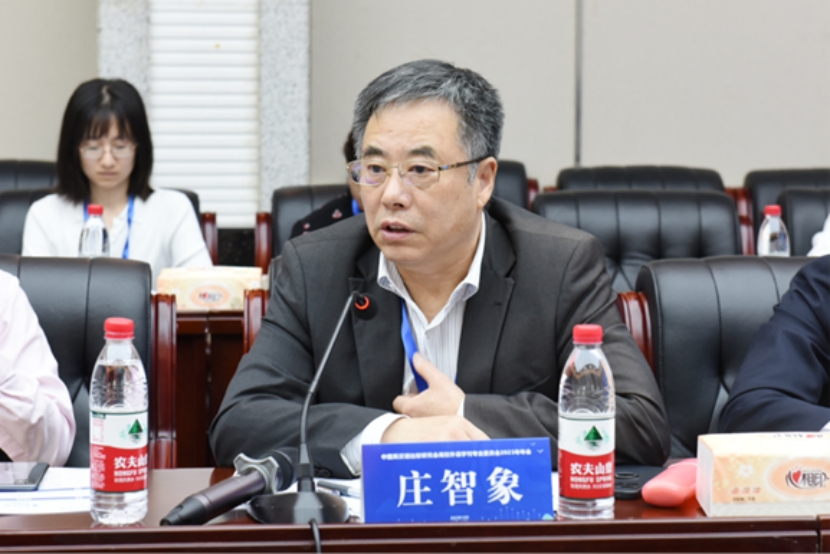
President Zhuang Zhixiang emphasized the importance of strengthening talent cultivation, advancing academic journals, and seizing historical opportunities while addressing challenges. He outlined eight priorities for the field. First, journals should implement the guiding principles of the 20th National Congress of the CPC to steer disciplinary development, embrace new development philosophies, and promote high-quality growth. Second, they should advance the New Liberal Arts initiative, refine disciplinary structures and knowledge systems, and serve both national needs and disciplinary advancement. Third, they should enhance teaching content and quality to drive disciplinary progress. Zhuang noted that journal development essentially extends the university's core functions in teaching, research, talent cultivation, cultural service, and knowledge transmission. He further called for greater interdisciplinary integration, the preservation of foundational strengths through innovation, and the maintenance of foreign language and literature as a distinct and independent discipline. Fourth, journals should promote academic exchange and collaboration to foster progress and prosperity. Fifth, they should elevate teaching and research standards, enrich course content, and provide students with robust academic platforms. Sixth, they should facilitate cultural exchange by disseminating outstanding achievements across all sectors, thereby enriching spiritual life and improving quality of life. Seventh, they must uphold rigorous standards in political orientation, content quality, academic excellence, and linguistic literacy, remaining accountable to both authors and readers. Eighth, the Committee should continue to build its organizational capacity, support the sustainable development of foreign language journals, meet the evolving needs of the discipline, and guide its future growth.
During the keynote session, representatives of various journals shared their development histories and the missions and responsibilities of foreign language journals in the new era. Professor Fan Wuqiu, Executive Editor-in-Chief of Foreign Languages and Translation, moderated the session.
Professor Wang Kefei, Editor-in-Chief of Foreign Language Teaching and Research, spoke first, presenting the journal's history and sharing its management experience.
Professor Shu Dingfang, Editor-in-Chief of Journal of Foreign Languages, reaffirmed his commitment to the journal's founding mission and to strengthening its foundational work. He noted that the journal focuses on traditional linguistics and translation studies, and stressed that foreign language journals must embrace new media and technologies to keep pace with evolving publishing formats.
Professor Huang Guowen, Editor-in-Chief of Foreign Languages in China, introduced the journal’s development, highlighting its “Reform Forum” and “Curriculum-based Ideological and Political Education” columns. He expressed hope that foreign language journals would further contribute to the development of China’s foreign language disciplines and society.
Professor Ran Yongping, Editor-in-Chief of Modern Foreign Languages, stated that journals should play a constructive role in the discipline, support teachers’ academic development, reflect national needs, and mirror social realities. He emphasized that journals must address real-world issues while maintaining their distinct positioning and characteristics.
Professor Fu Jingmin, Editor-in-Chief of Shanghai Journal of Translators, noted that the journal specializes in applied translation studies, exploring the relationships between translation and policy, education, economy, culture, discipline, and technological development. He observed that translation transcends language and text as a behavior, event, and phenomenon, and that translation studies must evolve with the times, keep pace with current trends, and align with national needs.
Professor Lyu Shenglu, Deputy Editor-in-Chief of Foreign Language Education, discussed the planning of traditional columns such as image construction and national translation. He stressed that translation should serve as the foundation for enhancing the effectiveness and quality of international communication, while also promoting Chinese language studies to support international education.
Professor Chen Yong, Editor-in-Chief of Foreign Languages Bimonthly, presented the journal’s development and future goals, affirming its commitment to diligent editorial work, innovation, and interdisciplinary research.
Professor Ji Xiuming, Deputy Editor-in-Chief of Foreign Languages and Their Teaching, introduced the journal's profile and recent developments, emphasizing the importance of active participation in academic exchanges.
Professor Li Dejun, Editor-in-Chief of Foreign Languages Research, noted that in the new era, foreign language journals should remain anchored in the core of foreign language studies and avoid blindly following trends.
Ms. Li Xinran, editor of Foreign Language World, introduced the journal’s content, development, and positioning. She noted that dialogue between researchers and practitioners remains indispensable yet limited, and raised concerns regarding the professional identity of young editors.
Professor Guo Jianhui, Director of the Editorial Office of English Studies, outlined the journal’s development direction and expressed an optimistic vision for the future of foreign language journals and disciplines.
Professor Wang Zhuo, Editor-in-Chief of Shandong Foreign Language Teaching, discussed the opportunities and challenges facing disciplines and journals, noting that some submissions deviate from foreign language development priorities. She outlined three criteria for manuscript selection: serving national strategic needs, amplifying China’s voice, and highlighting original Chinese theories and practices.
Professor Wang Songhe, editor and reviewer of Foreign Language Research, introduced the journal’s specialized column, hoping to establish a sustained annual thematic column. He noted that journals should focus on pressing issues in the language field, such as the standardization of online discourse and the construction of online identities.
Professor Zhou Changyin, Executive Editor-in-Chief of Journal of Beijing International Studies University, shared the journal's recent developments. He noted that while maintaining traditional strengths, the journal continuously explores frontiers, with particular support for indigenous theoretical innovations such as embodied-cognitive linguistics and translator behavior research.
Professor Li Jianbo, Editor-in-Chief of Journal of Zhejiang International Studies University, analyzed current academic trends, including the impact and challenges of artificial intelligence. He argued that journals should uphold foundational strengths while innovating, promote the development and prosperity of foreign language disciplines, and contribute to building a community with a shared future for humanity.
Professor Tian Hailong, Editor-in-Chief of Discourse Studies Forum, introduced the journal's content and development, expressing hope for enhanced communication and mutual support among academic journals.
Professor Sun Yi, Editor-in-Chief of Journal of Guangdong University of Foreign Studies, presented the journal's development history and its planned featured columns.
Professor Ge Guilu, Editor-in-Chief of Foreign Languages and Literature Studies, introduced the journal's development history and main columns, including the history of revolutionary translation and discourse translation studies.
Professor Chai Hongmei, Editor-in-Chief of Foreign Languages Research in Northeast Asia, described the current state of foreign language journal development at Dalian University of Foreign Languages. She noted that Foreign Languages Research in Northeast Asia actively focuses on country and area studies, while Language Education focuses on international Chinese language education.
Ms. Chen Jingjing, Executive Editor of Foreign Studies, introduced the journal’s profile and development history, emphasizing its strict adherence to the "three-round review and five-pass proofreading" editorial protocol to promote the development of foreign language disciplines.
Mr. Zong Zheng, editor of Foreign Language Testing and Teaching, introduced the journal's focus on English language testing and teaching in China, discussing areas for improvement such as the review system and copyright.
Professor Jiang Lihua, editor of Foreign Languages and Cultures, presented the journal's featured columns, academic activities, publishing achievements, platform development, and its strategy of publishing both Chinese and English versions.
Ms. Deng Menghan, editor of Contemporary Foreign Language Studies, noted that under the leadership of Editor-in-Chief Yang Feng, the journal upholds the unity of ideological and academic quality. She added that journals have a responsibility to raise awareness in the academic community, proactively propose academic topics, and inspire scholars to pursue them.
Professor Liu Xiangdong, Executive Deputy Editor-in-Chief of Chinese Journal of Applied Linguistics, introduced the journal's development history and achievements. He noted that the journal focuses on introducing Chinese academic theories and achievements, and plans to launch new columns inviting highly cited Chinese authors to help disseminate Chinese scholarship abroad.
Professor Li Xiaoqing, Executive Deputy Director of the Periodical Press of Sichuan International Studies University, highlighted the need to nurture new academic talent. She noted that given the time costs and realities of academic evaluation, cultivating young scholars requires significant investment, and expressed hope for strengthened exchanges and cooperation among foreign language journals.
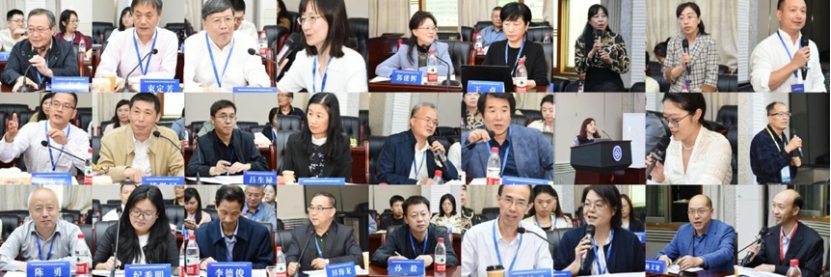
In his closing remarks, President Zhuang Zhixiang thanked all journal representatives for their presentations and the School of Foreign Languages, CSU, for organizing the conference. He noted that the positioning of foreign language journals should be continuously adjusted and refined rather than constantly redefined. At the same time, the development of featured columns requires long-term accumulation and persistence. Zhuang emphasized that journal development requires both resolve and vision: maintaining clear journal positioning, developing distinctive columns, valuing talent cultivation, promoting core socialist values, and serving the nation's development strategies.









 Dean's Email
 Alumni Home

 中文
中文
 Navigation
 Navigation


